HTN 2026 Badge Case
Tags: Reverse Engineering / 3D Printing / 3D CAD / Rapid Prototyping
← See all ProjectsIntroduction
I signed up to volunteer at Hack The North 2026, in doing so we were required to take at least one overnight shift. During this overnight shift I had met Matt Rudy, a Solona rep who wanted a case for for the PCB badges that were also made by Solona.
Design Constraints
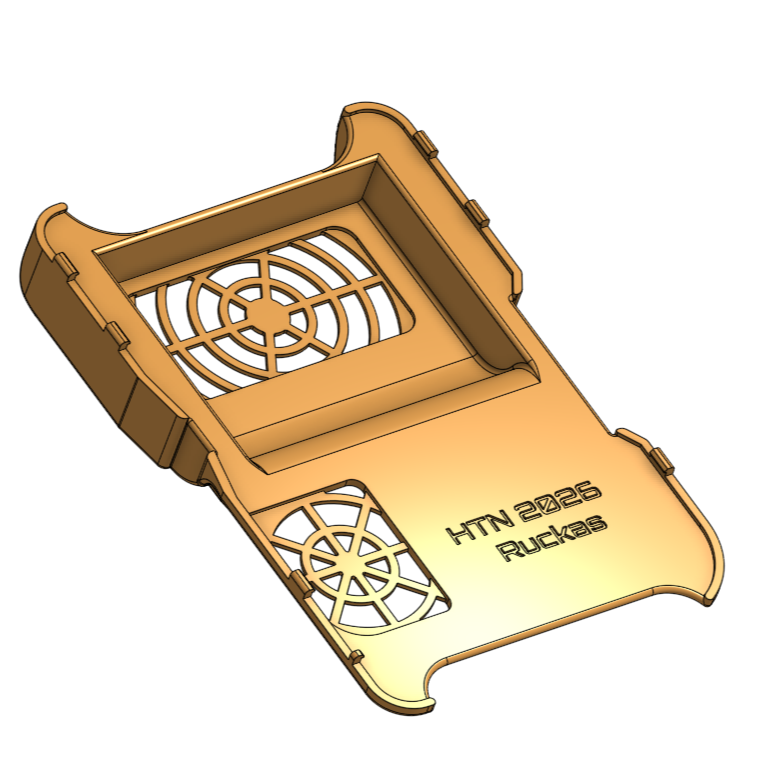
This project was done in roughly 3 hours including setting up the 3D printer, the main challenge of it was being restricted to using OnShape on a track pad and working on it from 4am to 7am. Thermals and user operation were 2 major design constraints that needed to be considered, along with designing it to be 3D Printed.
Design Solutions
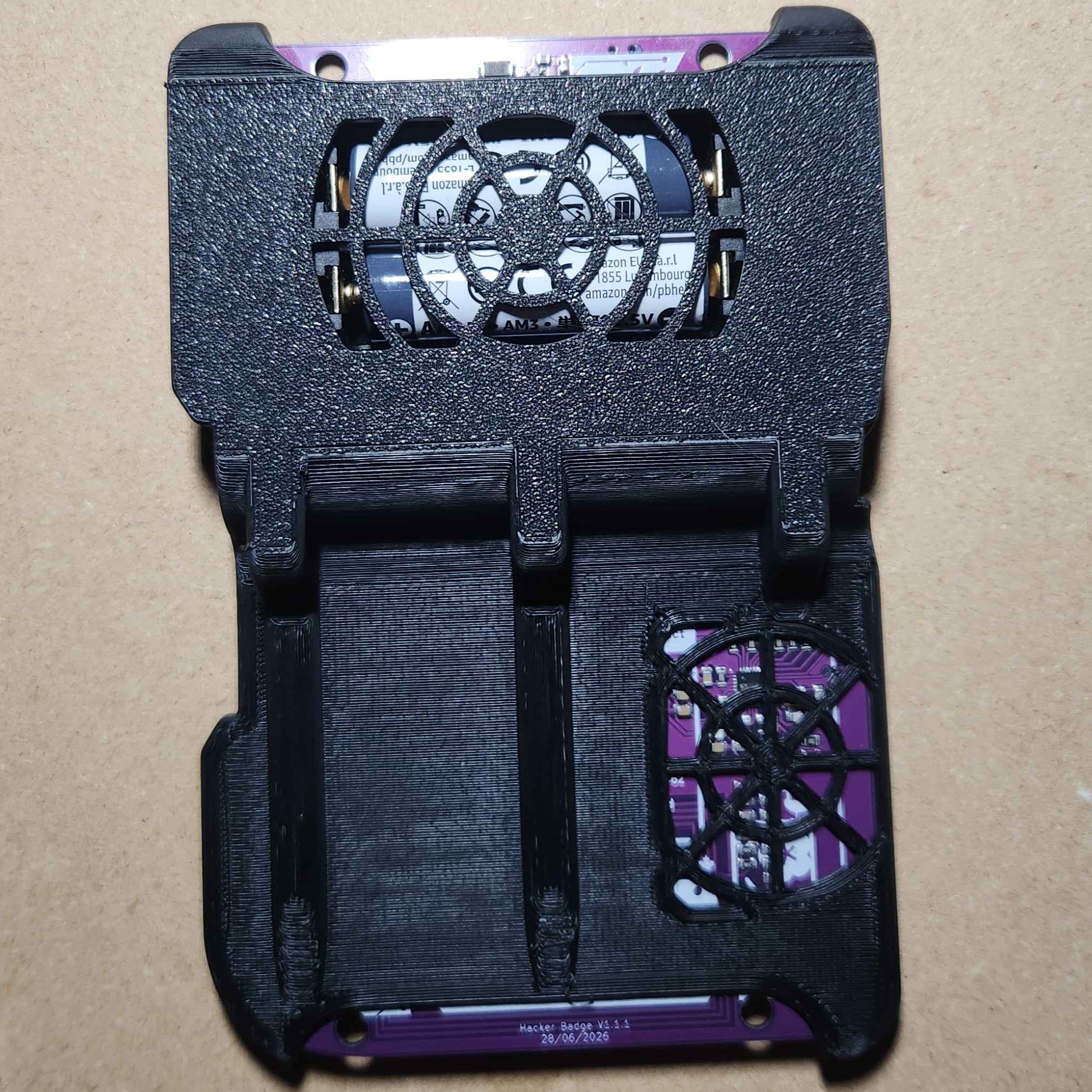
During operation the thermals from the battery and the LDO may be enough to melt the plastic if directly contacting the hot components. To resolve this a vent was placed over the components to avoid direct contact between the user and the hot components while still allowing airflow.
It was also important to consider user interaction with the device both while the device was being held/operated and while it was sitting on their lanyard. The formfactor of the case was kept as close to the actual dimensions as possible, cutouts for the charging port and on/off switch for easy access, and open sections for the mounting holes were all added to ensure the device can be used in the exact same ways with and without the case.
Considering the case needed to be 3d printed and all the surfaces are quite thin, the way the case was stiffened up was by adding ribbing on the back of the case. This ribbing increases the strength of the case by a significant margin. Due to the change in height of this ribbing the print can come off the print bed messy if the support height settings are not fine tuned.